
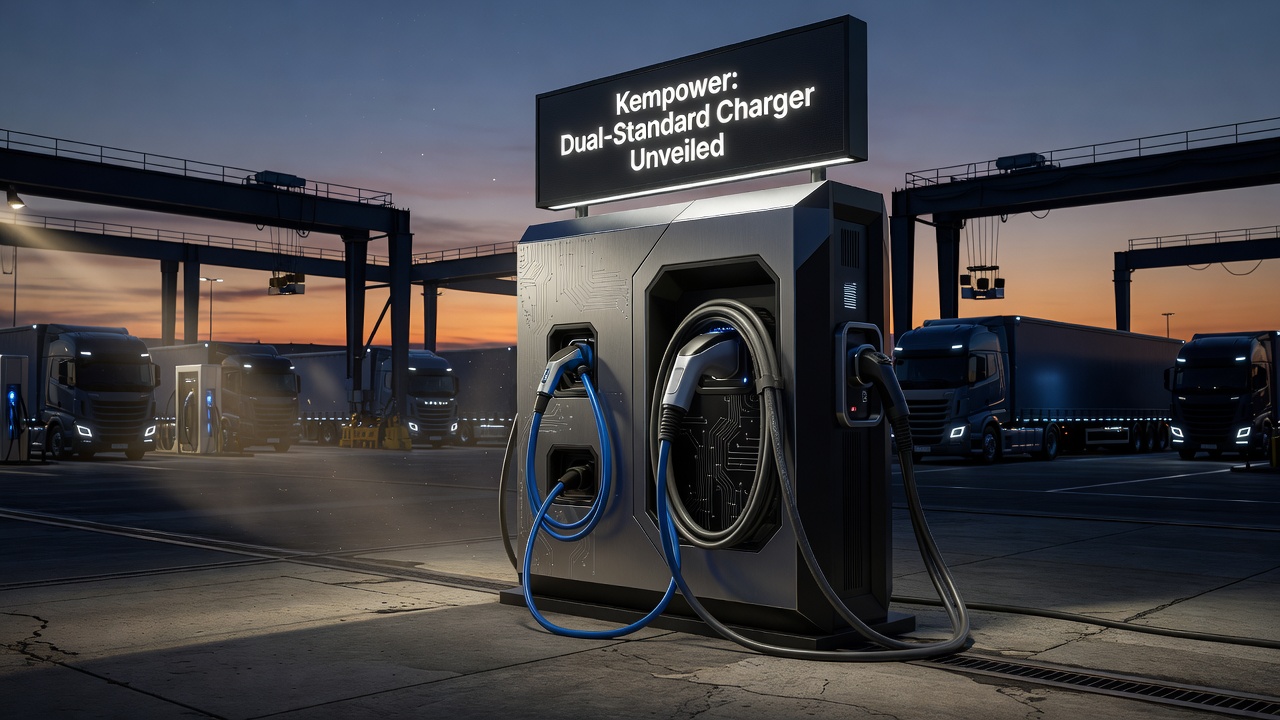
A single charging dispenser that can serve both a passenger sedan and a fully loaded semi-truck sounds like a modest engineering feat, but it addresses one of the thorniest problems in electric vehicle infrastructure: how to avoid building two parallel networks for two very different classes of vehicles. Kempower, the Finnish charging hardware maker, unveiled that solution this week with its Mega Satellite Flex, a charger capable of delivering up to 560 kW through the established CCS standard or up to 1.2 MW through the emerging Megawatt Charging System, known as MCS.
The announcement came at ACT Expo, during Kempower's Unplug & Recharge event for customers and partners, where the unit is on display through the rest of the week. Just as internet users increasingly rely on flexible, future-proofed tools rather than single-purpose ones - the same logic that drives interest in a vpn with dedicated ip for consistent, adaptable access - charging site operators are now looking for hardware that adapts to whatever plugs in, rather than betting on one standard alone. That flexibility is the entire premise behind the Mega Satellite Flex.
Why Two Standards Matter Right Now
CCS, the Combined Charging System, has been the backbone of fast charging for passenger EVs for more than a decade. It works well for cars and light commercial vehicles, but it was never designed to move the enormous amounts of energy that heavy-duty trucks require to stay on tight delivery schedules. MCS was developed specifically to fill that gap, targeting charging sessions measured in megawatts rather than kilowatts, so a truck with a large battery pack can recharge in a time comparable to a mandatory driver rest break.
The catch is that MCS infrastructure is still in its early rollout phase, while CCS remains dominant and will stay relevant for years. Any operator building a site today faces a choice: commit to one standard and risk stranded investment, or install redundant hardware for both. Kempower's approach sidesteps that dilemma by putting both capabilities into a single dispenser, supporting up to 1,500 amps on the MCS side and 700 amps on CCS, with cable lengths of 5 meters and 2.7 meters respectively.
What It Means for Site Operators
Utilization is the metric that determines whether a charging site turns a profit. A dispenser sitting idle because it only serves one type of vehicle is dead capital. By serving cars and trucks from the same unit, and by supporting newer 800-volt EV architectures that can pull higher charging speeds, Kempower is betting that operators will see better returns from day one rather than waiting for a second phase of construction once MCS demand materializes. The unit can also include an integrated payment terminal, and it works with Kempower's existing distributed charging architecture, meaning operators already running Kempower systems can add the Mega Satellite Flex without reengineering their sites.
A Broader Signal for the Industry
The timing reflects where the electric trucking sector actually stands: a transition, not a finished market. Manufacturers, fleet operators, and charging providers are all making infrastructure bets before demand fully materializes, and hardware that hedges against standard fragmentation reduces that risk considerably. The Mega Satellite Flex is expected to reach North America and Europe in July 2026, giving the industry more than a year to prepare sites, permitting, and grid connections before the hardware itself becomes available.